
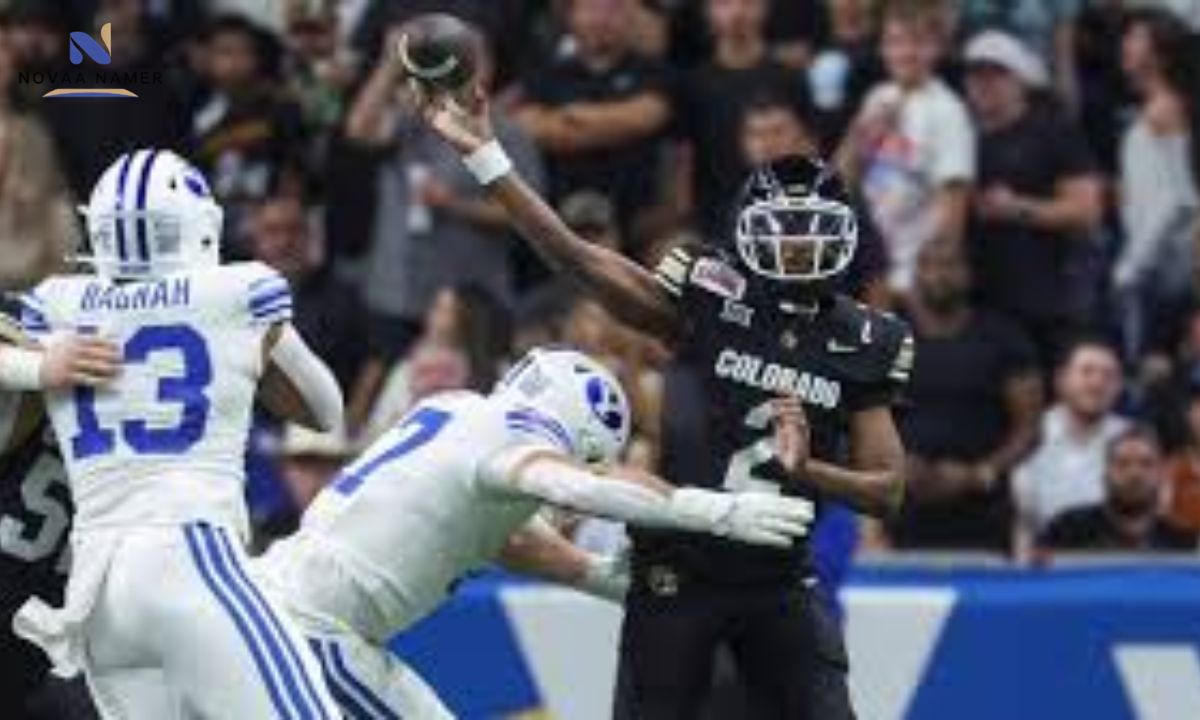
The byu football vs colorado buffaloes football match delivered an unforgettable spectacle of college football excellence at the Alamodome in San Antonio, Texas. This Alamo Bowl showdown brought together two Big 12 powerhouses, each carrying championship aspirations and exceptional talent rosters.
The December 28, 2024 encounter became a defining moment for both programs, with BYU securing a dominant 36-14 victory before a sellout crowd of 64,261 passionate fans. This wasn’t just another bowl game—it represented the culmination of remarkable seasons and showcased individual brilliance through detailed player statistics that told the complete story of the matchup.
Pre-Match Context and Team Backgrounds
BYU Football Team Overview
BYU arrived at the Alamodome riding momentum from an impressive 11-2 regular season campaign. The Cougars, ranked 17th in the College Football Playoff rankings, brought a well-coached squad under ninth-year head coach Kalani Sitake. Their identity centered on defensive excellence, disciplined execution, and opportunistic playmaking. The team’s defense had forced 22 interceptions during the season, leading the nation in that category.
Key strengths included:
- Balanced offensive attack led by quarterback Jake Retzlaff
- Nation-leading turnover creation with 27 forced turnovers
- Elite special teams unit with five touchdowns scored
- Strong running game anchored by LJ Martin and Sione Moa
The Cougars entered seeking redemption after missing the previous year’s bowl game and losses to Kansas and Arizona State that cost them a Big 12 Championship appearance. Defensive coordinator Jay Hill’s scheme emphasized pressure from multiple angles and confusing offensive coordinators with disguised coverages.
Colorado Buffaloes Team Overview
Colorado entered the byu football vs colorado buffaloes football match as the 23rd-ranked team, boasting one of college football’s most dynamic rosters. Head coach Deion “Coach Prime” Sanders had transformed the program in just two seasons, creating a nationally relevant team that sold out every home game. The Buffaloes finished 9-4 overall, featuring Heisman Trophy winner Travis Hunter and quarterback Shedeur Sanders—both projected first-round NFL Draft picks.
Colorado’s offensive firepower:
- Shedeur Sanders: 4,134 passing yards, 37 touchdowns, 74% completion rate
- Travis Hunter: 92 receptions, 1,152 yards, 14 receiving touchdowns
- Averaging 34.5 points per game (22nd nationally)
- Elite receiving corps with LaJohntay Wester (880 yards, 10 TDs)
The Buffaloes defense showed improvement throughout the season, with Cam’Ron Silmon-Craig leading the unit with 88 tackles. Despite offensive prowess, Colorado faced questions about offensive line consistency and rushing attack efficiency.
Pre-Game Predictions and Expert Opinions
Analysts predicted a high-scoring affair with Colorado favored by 2.5 points. The SP+ model gave BYU a 58% chance of victory, recognizing the Cougars’ defensive strength and Colorado’s offensive firepower. Experts emphasized quarterback play, turnover margin, and special teams execution as decisive factors. Many highlighted the emotional stakes—this marked the final collegiate game for Sanders and Hunter, while BYU sought to cap their season with an 11-win finish.
Latest Game Updates and Live Results
Final Score and Game Summary
BYU dominated from start to finish, building a commanding 20-0 halftime lead and cruising to a 36-14 victory. The Cougars controlled possession for 35:56 compared to Colorado’s 24:04, demonstrating superior time management and offensive efficiency. BYU scored in every quarter while holding Colorado scoreless until the third quarter, showcasing defensive mastery.
Scoring Summary:
- 1st Quarter: BYU 7, Colorado 0 (LJ Martin 1-yard TD run)
- 1st Quarter: BYU 10, Colorado 0 (Will Ferrin 51-yard FG)
- 2nd Quarter: BYU 17, Colorado 0 (Parker Kingston 64-yard punt return TD)
- Halftime: BYU 20, Colorado 0 (Will Ferrin 54-yard FG)
- 3rd Quarter: BYU 27, Colorado 0 (Sione Moa 13-yard TD run)
- 3rd Quarter: BYU 27, Colorado 7 (Travis Hunter 43-yard TD reception)
- 4th Quarter: BYU 33, Colorado 7 (LJ Martin 9-yard TD run)
- 4th Quarter: BYU 36, Colorado 7 (Will Ferrin 31-yard FG)
- Final: BYU 36, Colorado 14 (Sav’ell Smalls 2-yard TD reception)
The byu football vs colorado buffaloes football match showcased BYU’s superiority across all three phases. Colorado managed just 210 total yards with only two net rushing yards, while BYU accumulated 331 total yards including 180 on the ground.
Detailed Player Stats: BYU Football Performance
Offensive Player Stats
BYU’s offensive execution proved methodical and effective throughout the byu football vs colorado buffaloes football match. The Cougars converted 8-of-14 third-down attempts (57%), maintaining drives and controlling the clock.
Jake Retzlaff (Quarterback):
- 12-of-21 passing (57%)
- 151 passing yards
- 0 touchdowns, 2 interceptions
- 7 carries for 29 rushing yards
- Managed game effectively despite turnovers
LJ Martin (Running Back) – Offensive MVP:
- 16 carries for 88 rushing yards
- 2 rushing touchdowns
- 2 receptions for 33 yards
- 121 total yards from scrimmage
- Averaged 5.5 yards per carry with physical running
Sione Moa (Running Back):
- 13-yard rushing touchdown
- Contributed valuable short-yardage gains
- Complemented Martin effectively in backfield rotation
Receiving Corps:
- Darius Lassiter: Key third-down conversions (10 and 14-yard receptions)
- Ryner Swanson: 2 receptions for 30 yards
- Parker Kingston: 1 reception for 24 yards plus return duties
- Multiple receivers contributed to balanced attack
The offensive line dominated the line of scrimmage, creating running lanes and protecting Retzlaff sufficiently despite pressure.
Defensive Player Stats
BYU’s defense delivered a masterclass performance, confusing Shedeur Sanders with 17 different defensive looks in the first half alone. This strategic versatility overwhelmed Colorado’s offensive rhythm.
Isaiah Glasker (Linebacker) – Defensive MVP:
- 8 total tackles (4 solo)
- 1 tackle for loss
- 1 interception in fourth quarter
- Covered sideline-to-sideline with exceptional range
Pass Rush Excellence:
- Harrison Taggart: 1 sack for 10-yard loss
- Logan Lutui: 1 sack for 23-yard loss on critical drive
- Raider Damuni: 1 sack on unblocked safety blitz
- Siale Esera: 1 sack
- 4 total sacks, constant quarterback pressure
Secondary Performance:
- Evan Johnson: 1 interception
- Tanner Wall: Forced fumble with jarring hit leading to turnover
- Mory Bamba: 2 pass breakups
- Disciplined coverage limited big plays
The defensive unit held Colorado to minus-9 rushing yards in the first half and just 61 total yards before intermission. They limited Travis Hunter and LaJohntay Wester effectively through double coverage and physical play at the line.
Special Teams Performance
BYU’s special teams unit provided game-changing plays throughout the byu football vs colorado buffaloes football match, scoring one touchdown and establishing exceptional field position repeatedly.
Parker Kingston (Return Specialist):
- 3 punt returns for 82 yards
- 64-yard punt return touchdown
- 4 punt returns for 102 total yards
- 126 all-purpose yards
- Second punt return touchdown of season
Will Ferrin (Kicker):
- 3-of-3 field goals (51, 54, 31 yards)
- 4-of-5 extra points
- 54-yard field goal set Alamo Bowl record
- Perfect on kickoff placement
Successful onside kick recovery by Ethan Slade provided extra possession in first half. The special teams excellence consistently shifted momentum and provided advantageous field position.
Detailed Player Stats: Colorado Buffaloes Performance
Offensive Player Stats
Despite talent advantages, Colorado’s offense struggled against BYU’s aggressive defensive scheme. The Buffaloes managed just 22 first downs and converted only 3-of-9 third-down attempts (33%).
Shedeur Sanders (Quarterback):
- 16-of-23 passing (69.6%)
- 208 passing yards
- 2 touchdown passes
- 2 interceptions
- Sacked 4 times for 34 yards lost
- 9 carries for minus-34 yards
- Pressured constantly by BYU defense
Rushing Attack Struggles:
- Micah Welch: 5 carries for 25 yards (team leader)
- Total team rushing: 2 net yards
- Minus-9 rushing yards in first half
- Colorado averaged 0.1 yards per carry
- Offensive line dominated at line of scrimmage
Travis Hunter (Wide Receiver):
- 4 receptions for 106 yards
- 1 touchdown (43-yard reception)
- 8th game with 100+ receiving yards
- 15th receiving touchdown of season
- Also contributed 4 tackles on defense
LaJohntay Wester (Wide Receiver):
- 4 receptions for 51 yards
- Provided secondary receiving threat
- Struggled to create separation against BYU coverage
Sav’ell Smalls (Tight End):
- 1 reception for 2 yards
- 1 touchdown (final play of Sanders’ collegiate career)
The offensive line allowed consistent pressure, with Sanders hit on numerous throws and sacked four times. Colorado’s vaunted passing attack, which averaged 348 yards over their final three regular season games, managed just 208 yards.
Defensive Player Stats
Colorado’s defense faced relentless pressure from BYU’s methodical offensive approach. The Buffaloes showed moments of resistance but couldn’t sustain stops against BYU’s balanced attack.
Cam’Ron Silmon-Craig (Safety):
- 6 tackles
- 1.5 tackles for loss
- 1 interception
- Physical presence in secondary
Shilo Sanders (Safety):
- 8 tackles
- 1 pass breakup
- Interception on two-point conversion attempt
- Ended collegiate career with strong effort
BJ Green II (Pass Rush):
- Pressure on quarterback
- Season leader with 7.5 sacks
- Limited impact against BYU’s protection schemes
Charlie Nwankwo (Defensive Tackle):
- 1 sack
- Disrupted interior passing lanes
The defense struggled containing BYU’s running game, allowing 180 rushing yards and 4.3 yards per carry. Third-down defense proved problematic, with BYU converting 57% of attempts.
Special Teams Highlights
Colorado’s special teams had bright moments but couldn’t match BYU’s excellence in this phase.
Punt Coverage:
- Struggled containing Parker Kingston
- Allowed 82 yards on three returns including touchdown
- Coverage breakdowns proved costly
Field Goal Kicking:
- Missed one field goal attempt from 48 yards
- Extra points converted successfully
- Distance limitations exposed
Return Game:
- Limited opportunities due to field position disadvantages
- Unable to generate explosive plays
- Kick returns provided minimal field position gains
Player Performance Comparison Table
| Category | BYU | Colorado |
| Total Yards | 331 | 210 |
| Passing Yards | 151 | 208 |
| Rushing Yards | 180 | 2 |
| First Downs | 22 | 9 |
| 3rd Down Conversion | 8/14 (57%) | 3/9 (33%) |
| Time of Possession | 35:56 | 24:04 |
| Turnovers | 3 | 2 |
| Sacks | 1 | 4 |
| Penalties-Yards | 9-80 | 8-65 |
Head-to-Head Player Comparisons
Quarterback Battle: Jake Retzlaff vs Shedeur Sanders
Jake Retzlaff (BYU): Managed the game effectively despite two interceptions. His 151 passing yards and 29 rushing yards demonstrated dual-threat capabilities. Retzlaff made critical third-down conversions and avoided taking damaging sacks, showing excellent pocket awareness. His decision-making kept BYU’s offense balanced and on schedule throughout the byu football vs colorado buffaloes football match.
Shedeur Sanders (Colorado): Despite impressive 69.6% completion rate and 208 passing yards, Sanders faced constant pressure that disrupted Colorado’s rhythm. The four sacks and minus-34 rushing yards reflected BYU’s dominant defensive scheme. Sanders threw two touchdowns but also two interceptions, with the constant harassment preventing him from utilizing his full skill set. His 2-yard touchdown pass to Smalls concluded a historic collegiate career.
Edge: BYU—Retzlaff’s game management and ability to avoid negative plays proved superior in this matchup.
Running Game Comparison
BYU Running Backs: LJ Martin and Sione Moa combined for dominant ground performance. Martin’s 88 yards and two touchdowns on 16 carries (5.5 yards per attempt) established offensive tempo. Moa’s 13-yard touchdown and short-yardage contributions provided perfect complement. The duo consistently broke initial tackles and generated chunk plays.
Colorado Running Backs: Micah Welch’s 25 yards on five carries represented Colorado’s entire rushing attack. The Buffaloes’ inability to establish ground game (2 net yards total) eliminated offensive balance and forced Sanders into predictable passing situations. This dimensional limitation allowed BYU’s defense to pin ears back and pressure Sanders relentlessly.
Edge: BYU dominated—180 rushing yards versus 2 represented perhaps the game’s most decisive statistical category.
Wide Receiver Matchup
Travis Hunter (Colorado): The Heisman Trophy winner showcased why he’s special with 106 yards and a spectacular 43-yard touchdown on just four receptions. Hunter’s route running and ability to win contested catches remained elite. However, BYU’s defensive scheme limited his opportunities, targeting him with double coverage on most plays.
BYU Receiving Corps: While no individual receiver dominated statistically, BYU’s balanced approach featured multiple contributors. Darius Lassiter made critical third-down conversions, Ryner Swanson provided 30 yards on key drives, and Parker Kingston added 24 receiving yards while excelling in return game. The committee approach kept Colorado’s defense guessing and prevented focus on single receiver.
Edge: Colorado individually (Hunter’s talent unmatched), BYU collectively (balanced attack more effective)
Defensive Comparison
BYU Defense: Isaiah Glasker’s eight tackles and interception headlined dominant performance. The defense generated four sacks, two interceptions, multiple pass breakups, and one forced fumble. BYU’s 17 different defensive looks confused Sanders, and their aggressive blitzing from safeties Raider Damuni and linebackers created constant chaos. Holding Colorado to 210 total yards and 2 rushing yards represented defensive mastery.
Colorado Defense: Cam’Ron Silmon-Craig’s six tackles and interception plus Shilo Sanders’ eight tackles showed individual effort. However, the unit surrendered 331 yards, 180 rushing yards, and struggled on third down. Unable to generate consistent pressure on Retzlaff or contain BYU’s running game, Colorado’s defense couldn’t match their counterparts’ intensity during the byu football vs colorado buffaloes football match.
Edge: BYU decisively—one of the season’s most dominant bowl game defensive performances.
Key Moments That Influenced the Statistical Outcome
First Quarter Dominance
BYU’s opening drive statement set the tone. After forcing Colorado three-and-out, the Cougars marched 52 yards on six plays, culminating in LJ Martin’s 1-yard touchdown plunge. The drive featured Martin’s 28-yard reception and balanced play-calling that kept Colorado’s defense off-balance. Will Ferrin’s subsequent 51-yard field goal extended the lead to 10-0, establishing early momentum.
Parker Kingston’s Electrifying Punt Return
With 5:32 remaining in the second quarter and BYU leading 10-0, Parker Kingston fielded a Colorado punt and wove through defenders for a stunning 64-yard touchdown. This special teams explosion demoralized Colorado and exemplified BYU’s three-phase dominance. The return represented the first punt return touchdown in Alamo Bowl history since 2017 and Kingston’s second of the season.
Halftime Field Goal Record
Will Ferrin’s 54-yard field goal as time expired in the first half set an Alamo Bowl record, breaking Cameron Dicker’s 53-yarder from 2020. The kick gave BYU a commanding 20-0 halftime advantage and showcased the Cougars’ confidence. Colorado had managed just 61 total yards in the half, including minus-9 rushing yards, setting a dismal tone for the Buffaloes.
Logan Lutui’s Critical Sack
Early in the second quarter with Colorado threatening inside BYU’s 10-yard line, defensive end Logan Lutui demolished Sanders for a 23-yard loss. This momentum-crushing play forced a long field goal attempt that Colorado missed, preserving BYU’s shutout. The sack exemplified BYU’s aggressive defensive approach and defensive coordinator Jay Hill’s brilliant play-calling.
Travis Hunter’s Lone Highlight
Hunter’s 43-yard touchdown reception from Sanders with 6:14 remaining in the third quarter represented Colorado’s first points and briefly energized the Buffaloes, cutting the deficit to 27-7. The play showcased why Hunter won the Heisman Trophy, as he beat double coverage and displayed exceptional speed. However, BYU responded immediately with continued dominance, preventing any Colorado comeback momentum.
Fourth Quarter Sealing Plays
LJ Martin’s 9-yard touchdown run, dragging multiple defenders, extended BYU’s lead to 33-7 with 10:23 remaining. Isaiah Glasker’s fourth-quarter interception along the sideline set up Will Ferrin’s third field goal, making it 36-7. These plays sealed Colorado’s fate and sent Buffaloes fans toward the exits during the byu football vs colorado buffaloes football match.
Statistical Takeaways and Expert Insights
BYU’s Dominant Performance
Experts analyzing the byu football vs colorado buffaloes football match emphasized several factors behind BYU’s comprehensive victory:
Defensive Scheme Mastery: Jay Hill’s defensive game plan confused Sanders with disguised coverages and pressures from unpredictable angles. The 17 different defensive looks in the first half alone demonstrated exceptional preparation. Tyler Batty noted post-game, “We had guys flying in from every angle putting pressure on the quarterback. I don’t necessarily envy Shedeur in that situation.”
Physical Rushing Attack: BYU’s 180 rushing yards versus Colorado’s 2 yards represented dominant line play. The Cougars averaged 4.3 yards per carry while Colorado managed 0.1 yards per attempt—a 43-to-1 ratio showcasing complete physical superiority.
Special Teams Excellence: Parker Kingston’s punt return touchdown and Will Ferrin’s record-setting field goal provided 17 points and exceptional field position throughout. BYU’s special teams unit scored their fifth touchdown of the season and maintained perfect execution.
Time of Possession: Controlling the ball for 35:56 versus 24:04 kept Colorado’s offense off the field and exhausted the Buffaloes’ defense. BYU’s methodical drives sustained by third-down conversions proved crucial.
Colorado’s Struggles Analyzed
Offensive Line Breakdown: Deion Sanders acknowledged post-game, “BYU, they’re well-coached. They did a phenomenal job running the football. Special teams kicked our butts and we couldn’t do nothing offensively much at all.” The offensive line’s inability to protect Sanders or create rushing lanes eliminated offensive balance.
First Half Disaster: Shut out 20-0 at halftime for only the second time all season, Colorado managed three first downs, 70 passing yards, and minus-9 rushing yards. This represented complete offensive collapse against BYU’s aggressive scheme.
Inability to Adjust: Colorado entered averaging 34.5 points per game (22nd nationally) but managed just 14 points. The Buffaloes’ 90 yards in the fourth quarter, with BYU leading by 29 points, came against prevent defense, inflating final statistics.
Shedeur Sanders reflected, “We started to identify and we started with the rhythm of things, but we just wasn’t connecting overall. That’s what stopped us overall, was ourselves.”
Individual Standout Performances
LJ Martin (BYU): The Alamo Bowl Offensive MVP finished his sophomore season with statement performance. His 121 yards from scrimmage and two touchdowns demonstrated power, vision, and balance. Martin led BYU in both rushing (88 yards) and receiving (33 yards), showcasing versatility.
Isaiah Glasker (BYU): The Alamo Bowl Defensive MVP’s eight tackles, tackle for loss, and interception capped BYU’s defensive dominance. His sideline-to-sideline range and instincts disrupted Colorado’s offensive rhythm throughout.
Travis Hunter (Colorado): Despite the loss, Hunter’s 106 yards and touchdown on four receptions maintained his Heisman-worthy standard. His 15th receiving touchdown of the season and eighth 100-yard game demonstrated sustained excellence even in defeat.
Record-Setting Statistics
- Will Ferrin: 54-yard field goal set Alamo Bowl record
- BYU Defense: Nation-leading 22 interceptions for 2024 season
- Attendance: 64,261 sellout crowd (12th-highest in Alamo Bowl history)
- Viewership: 8.0 million viewers (highest non-CFP bowl game)
- BYU Special Teams: Five total touchdowns scored during 2024 season
Recent Search Updates and Current News
Post-Game Reactions and Analysis
Following the byu football vs colorado buffaloes football match, both programs received extensive media coverage examining performances and futures. BYU finished 11-2, securing their 13th ranking in the final AP Poll—one of their best seasons in program history. Colorado concluded at 9-4, marking their best finish since 2016 and first bowl appearance since 2020.
Shedeur Sanders’ Draft Stock: Despite the loss, Sanders declared for the 2025 NFL Draft and was subsequently selected by the Cleveland Browns in the fifth round (144th overall pick). While drafted later than many projected, Sanders has shown promise in his rookie NFL season, recently throwing for 180 yards and two touchdowns in the first half against Tennessee.
Travis Hunter’s Historic Career: Hunter’s college career concluded as one of the most remarkable in football history. The two-way star finished with 96 receptions for 1,258 yards and 15 receiving touchdowns while adding 32 tackles, 11 pass breakups, and four interceptions on defense. He became the first player to earn first-team Walter Camp All-American honors on both offense and defense in the award’s 135-year history.
Jake Retzlaff’s Future: Retzlaff returned for the 2025 season as BYU’s starting quarterback before transferring to Tulane following off-field issues. He finished 2024 with 2,947 passing yards, 20 touchdowns, 417 rushing yards, and six rushing touchdowns, leading BYU to their 11-2 record.
LJ Martin’s Breakout: Following his Alamo Bowl MVP performance, Martin exploded in 2025, leading the Big 12 in rushing yards (1,229), yards per game (102.4), and all-purpose yards (1,453). He became a semifinalist for the Earl Campbell Tyler Rose Award, solidifying his status as one of college football’s premier running backs.
Bowl Game Records and Legacy
The byu football vs colorado buffaloes football match established several notable records and milestones:
- Most-watched non-CFP bowl game of the 2024 season (8.0 million viewers)
- Alamo Bowl field goal record (54 yards by Will Ferrin)
- BYU’s most dominant bowl victory in recent history (alongside 2009 Las Vegas Bowl and 2020 Boca Raton Bowl)
- Second-highest attendance for two out-of-state teams in Alamo Bowl history
- First punt return touchdown in Alamo Bowl since 2017
Frequently Asked Questions
What was the final score of the byu football vs colorado buffaloes football match?
BYU defeated Colorado 36-14 in the Alamo Bowl on December 28, 2024, at the Alamodome in San Antonio, Texas.
Who was the MVP of the byu football vs colorado buffaloes football match?
LJ Martin earned Offensive MVP honors with 121 yards from scrimmage and two touchdowns, while Isaiah Glasker won Defensive MVP with eight tackles and an interception.
How many yards did Travis Hunter have in the game?
Travis Hunter recorded 106 receiving yards and one touchdown on four receptions, marking his eighth 100-yard game of the season.
What were Shedeur Sanders’ stats in the Alamo Bowl?
Shedeur Sanders completed 16-of-23 passes for 208 yards, two touchdowns, and two interceptions while being sacked four times.
How many rushing yards did Colorado have as a team?
Colorado managed just 2 net rushing yards on 25 carries, averaging 0.1 yards per attempt against BYU’s dominant defensive front.
What records were set during the byu football vs colorado buffaloes football match?
Will Ferrin set an Alamo Bowl record with a 54-yard field goal, and the game drew 8.0 million viewers, making it the most-watched non-CFP bowl game.
How many interceptions did BYU finish the 2024 season with?
BYU finished the 2024 season with a nation-leading 22 interceptions, recording at least one interception in all 13 games including the Alamo Bowl.
Conclusion
The byu football vs colorado buffaloes football match represented college football at its finest—intense competition, exceptional athleticism, and strategic brilliance. BYU’s comprehensive 36-14 victory demonstrated their superiority across all phases: offense, defense, and special teams. The Cougars’ physical running game, aggressive defensive scheme, and electrifying special teams plays overwhelmed Colorado’s talented roster.
LJ Martin’s 88 rushing yards and two touchdowns earned Offensive MVP honors while establishing BYU‘s ground dominance. Isaiah Glasker’s Defensive MVP performance, featuring eight tackles and an interception, headlined a defense that held Colorado to season-low offensive totals. Parker Kingston’s 64-yard punt return touchdown and Will Ferrin’s record-setting 54-yard field goal provided special teams excellence that shifted momentum decisively.

David is a passionate writer and creative thinker who shares unique insights on Novaanamer. With a love for exploring names, ideas, and meaningful content, he brings fresh perspectives to help readers find inspiration, creativity, and knowledge in everyday life. His goal is to make complex topics simple and engaging for everyone.